Editable Streetwear Neck Label Templates for Brand Identity
Building a clothing line is one thing; making it feel legitimate is another. In the streetwear market, the details are what separate a garage startup from a recognizable brand. While the graphic on the front of the t-shirt gets the attention, the label on the neck is what creates the customer experience. It’s the tactile proof of quality. This is where using professional Editable Streetwear Neck Label Templates becomes a game-changer for designers and small business owners. You aren't just printing a logo; you are constructing a cohesive brand identity from the inside out.
These templates are designed specifically for the unique aesthetic of urban fashion. Unlike generic office labels or minimal high-fashion tags, streetwear neck labels often feature bold typography, edgy graphics, and specific information hierarchy that resonates with the culture. The visual personality of these templates usually leans toward high contrast and assertive layout. They are built to handle the rough-and-tumble vibe of street culture while maintaining the professionalism required for retail. When you use a vector-based template, you are starting with a foundation that understands the style, allowing you to customize the specifics without needing to be a master typographer from scratch.
The Power of 100% Vector Assets in Your Workflow
One of the most critical aspects of these assets is the file format. You will receive 100% Vector sources files in EPS formats, alongside high-resolution JPGs for reference. For the uninitiated, "vector" is the golden standard in design. It means the artwork is made of mathematical paths rather than pixels. This is vital for packaging design and label creation because it allows you to scale up and down infinitely without losing quality.
If you try to scale a standard image (raster) of a logo to fit a tiny neck label, it often becomes blurry or pixelated. With vector files, you can shrink a complex design down to a fraction of an inch, and the lines remain crisp. Conversely, if you want to take a design element from your neck label and blow it up for a billboard or a large back-print on a hoodie, the quality remains pristine. This flexibility is non-negotiable for serious brand identity work. You can easily transform, scale up and down, add and remove elements or text, recolor without losing the quality. This capability ensures that whether you are using Adobe Illustrator, Affinity Designer, or CorelDRAW, you have total control over the final output.
Practical Customization: Cotton Tags and Care Instructions
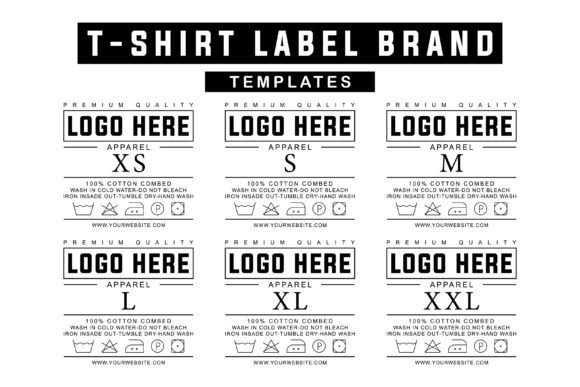
A neck label serves a dual purpose: branding and legal compliance. In most countries, clothing sold to consumers must have specific information regarding fiber content and care. The templates focus on Cotton garment tags with sizes and care instructions, which covers the vast majority of streetwear production.
When you open these files, you’ll find that the layout is already structured to accommodate the necessary legal text without cluttering the design. You can easily edit the composition to include:
- Brand Name and Logo: The focal point of the tag.
- Sizing Information: Clear indicators for S, M, L, XL, etc.
- Fabric Content: Typically 100% Cotton or specific blends.
- Care Symbols: Wash, bleach, dry, and iron instructions.
- Country of Origin: Required for international trade.
Because these are customizable unisex clothing tag label brand templates, the aesthetic is versatile enough to work for men’s, women’s, or unisex collections. The ability to edit vector files means you can adjust the kerning (spacing between letters) to fit longer brand names or tweak the layout to accommodate bilingual text if you are selling in international markets.
Application Across Creative Projects
While the primary use is physical garment labeling, the utility of these design assets extends far beyond the sewing room. The visual language of streetwear—gritty textures, bold sans-serif fonts, and high-contrast layouts—is a dominant force in modern marketing.
As a content creator or marketer, you can repurpose elements of these neck label templates for digital use. For instance, the badge-style graphics often found on these labels look fantastic as watermarks on photography or as corner accents on social media graphics. If you are a blogger covering fashion, you might use these templates to mock up concepts for articles discussing modern typography trends.
For web design, the "tag" aesthetic can be used as UI elements, such as buttons, price tags for e-commerce sites, or "New Arrival" badges. The consistency of using the same visual language across your physical product and your digital presence is what builds a strong brand identity. It tells your audience that you pay attention to details, which builds trust.
Evaluating Font Pairings and Typography
Typography is the voice of your brand. When working with these templates, you aren't just looking at shapes; you are dealing with typefaces. Streetwear labels often utilize sans serif fonts for their clean, modern look, but you might also encounter display fonts or script fonts used for accent text.
A key part of the design process is evaluating font pairing. If the template uses a heavy, blocky display font for the brand name, you might want to pair it with a clean, legible sans-serif for the size and care instructions. This creates a visual hierarchy that guides the eye. Avoid using two decorative fonts together, as it usually results in visual chaos.
Consider the readability at a very small scale. A complex handwritten font might look cool on a poster, but on a 1-inch neck label, it can turn into an unreadable squiggle. Stick to high-contrast pairings. If you decide to change the fonts within the vector file, ensure you have the proper commercial font licenses for the typefaces you install, especially if you are selling the final garments commercially.
Consistency and Professionalism in Production
Using Editable Streetwear Neck Label Templates is not just about saving time; it is about standardization. When you send your designs to a manufacturer or a print shop, ambiguity is the enemy. Vector files remove ambiguity. They provide clear paths for cutting machines and screen printing setups.
By using these templates, you ensure that every single garment in your run has the same professional finish. This consistency is what separates hobbyists from business owners. It affects how the customer perceives the garment's value. A well-designed, properly printed neck label suggests that the rest of the garment is also high quality. It creates a tactile experience that encourages brand loyalty.
Ultimately, these templates provide a professional starting point. They give you the structure of a premium font layout and the flexibility of vector editing. Whether you are a graphic designer building a portfolio or an entrepreneur launching a drop, having high-quality, editable source files for your labeling is a strategic asset that pays dividends in brand perception and production efficiency.